

If you have ever been scrolling through your messages, TikTok comments, or Snapchat chats and suddenly spotted the word IONK, you are not alone. It is one of those internet slang terms that pops up without warning and leaves people puzzled. Whether you saw it in a group chat, a meme caption, or a DM, understanding what IONK means helps you keep up with today’s fast-moving digital language.
In this guide, you will learn everything about IONK, its definition, origin, how to use it across different platforms, and when you should (and should not) use it. Let us get into it.
Definition & Meaning
IONK stands for “I don’t know.” It is a casual, phonetic slang abbreviation used in texting and online conversations to express uncertainty or a lack of information. The term belongs to the broader family of informal digital communication shortcuts, much like IDK, LOL, and BRB.
What makes IONK different from a straightforward “IDK” is its tone. IONK sounds more natural and conversational, almost like how someone would mumble “I dunno” quickly in real life. It carries a relaxed, playful energy that keeps conversations moving without coming across as cold or overly formal.
Quick example:
Friend: “What time does the party start?” You: “IONK, maybe check the group chat.”
In this case, IONK replaces a full explanation with a fast, friendly shrug. That simplicity is exactly what makes it so popular in today’s fast-paced messaging culture.
Background & History
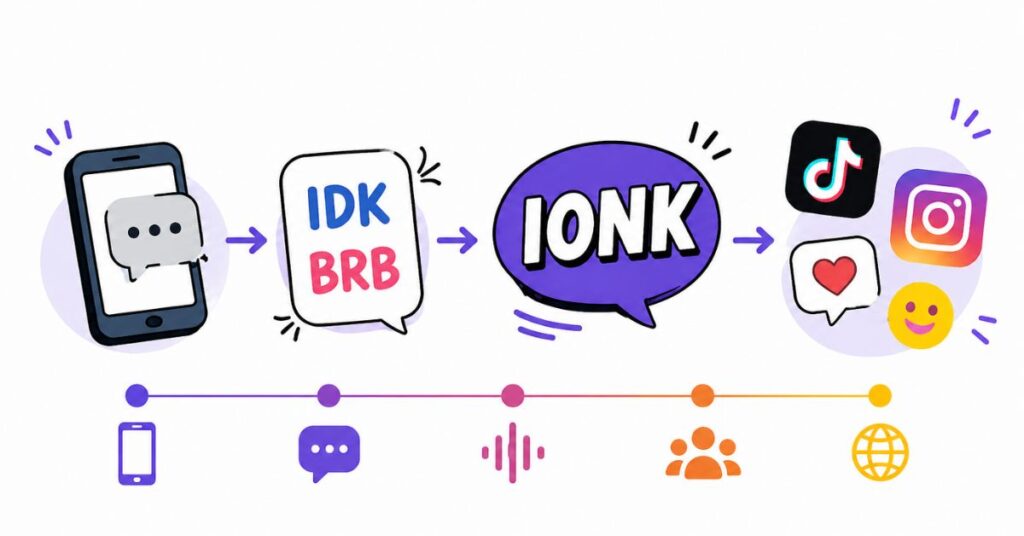
The story of IONK begins with the broader evolution of texting language in the early 2010s. As smartphones became mainstream and platforms like Snapchat, Kik, and later TikTok took over daily communication, users, especially teenagers and young adults, started reshaping language to fit the speed of their conversations.
Early abbreviations like IDK (I don’t know) and BRB (be right back) paved the way. But over time, a new generation of users began spelling words the way they sounded out loud rather than following standard abbreviations. That phonetic trend gave birth to terms like IONK, which closely mirrors how “I don’t know” sounds when said quickly in casual speech.
By the mid-2010s, IONK was circulating in group chats, comment sections, and social media captions across the United States. As TikTok and Instagram Reels grew in influence, the term spread even further, carried by memes, viral videos, and Gen Z content creators who embedded it naturally into their posts and replies.
Today, IONK is a recognized piece of youth texting language, a product of how digital culture continuously reshapes English to fit new communication styles.
Usage in Various Contexts
IONK is a flexible term that adapts to many different online spaces. Its meaning stays consistent, “I don’t know,” but the tone shifts depending on where and how it is used.
| Platform | How IONK Is Used | Tone |
| Texting | Responding to questions with uncertainty | Casual, relaxed |
| TikTok | Captions reacting to confusing trends | Humorous, playful |
| Snapchat | Replying quickly in DMs or stories | Light, social |
| Discord/Gaming | Admitting confusion about strategies | Frustrated or joking |
| Dating Apps | Bios or chats for a low-key vibe | Flirty, easygoing |
In everyday texting, it shows up when someone does not want to type a long response. A quick “IONK” tells the other person you are unsure while keeping the conversation going.
On social media, especially TikTok and Instagram, users pair IONK with emojis to add humor or irony. A caption like “Everyone’s into this trend but IONK why” is relatable, funny, and speaks to a wide audience instantly.
In gaming communities, particularly Discord servers, players drop IONK when unsure about game mechanics, level strategies, or group plans. It fits naturally into the fast-typing culture of gaming chats.
Common Misconceptions & Clarifications
Because IONK is relatively new and not as mainstream as IDK, several misunderstandings exist around it.
- “It’s just a typo.” This is the most common assumption. Many people seeing IONK for the first time assume someone meant to type IDK and hit the wrong keys. In reality, IONK is an intentional, phonetic slang term with its own identity.
- “IONK and ION mean the same thing.” They do not. ION is a separate slang term that typically means “I don’t” (as in “ion care” = “I don’t care”) or sometimes “In Other News.” IONK specifically and always means “I don’t know.”
- “Everyone understands it.” Not quite. IONK is most familiar to younger, digitally active users in the United States and other English-speaking regions. Older users or those outside Western social media culture may not recognize it at all.
Similar Terms & Alternatives
IONK belongs to a family of informal expressions that all mean roughly the same thing: “I don’t know.” Understanding how they compare helps you choose the right one for the right moment.
| Term | Full Meaning | Tone | Best Used In |
| IONK | I don’t know | Playful, phonetic, youth-focused | Texting, social media, gaming |
| IDK | I don’t know | Neutral, universal | Any informal context |
| Dunno | I don’t know | Very casual, spoken | Texting, real conversation |
| Not Sure | I don’t know | Semi-formal | Mixed or professional-ish contexts |
| No Clue | I have no idea | Casual, emphatic | Informal chats |
| Beats Me | I don’t know | Laid-back, slightly humorous | Conversational exchanges |
The key difference between IONK vs IDK is tone. IDK is the standard go-to clean, quick, and recognized by all age groups. IONK adds personality and sounds more like natural speech. If IDK is a shrug, IONK is a shrug with a grin.
How to Respond to This Term
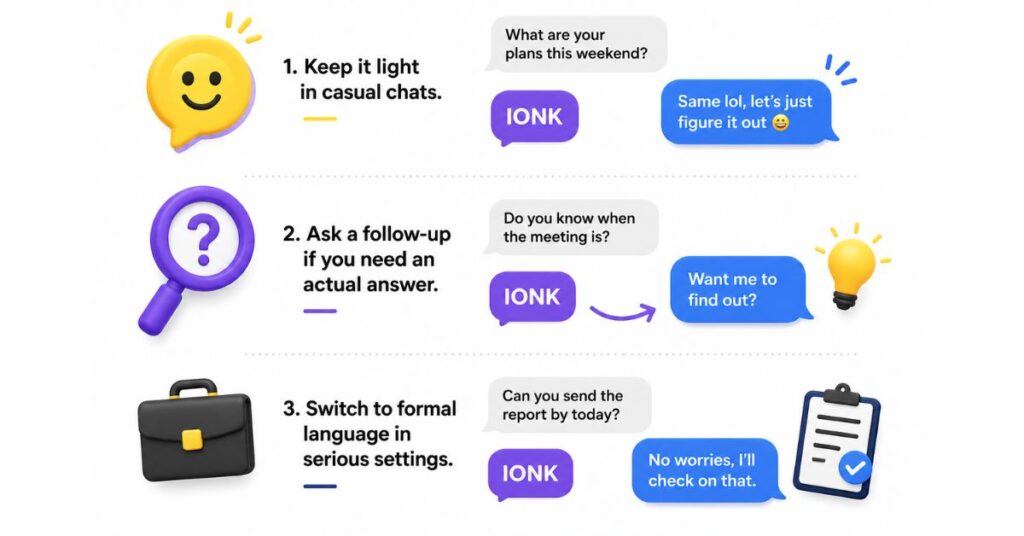
When someone sends you IONK, how you respond depends entirely on the mood of the conversation.
- Keep it light in casual chats. If a friend replies “IONK” to a question about weekend plans, you can say something like “Same lol, let’s just figure it out” or follow up with a fun suggestion.
- Ask a follow-up if you need an actual answer. IONK does not always mean the person is refusing to help. A friendly “Want me to find out?” keeps things moving.
- Switch to formal language in serious settings. If you are the one receiving IONK in a professional or semi-professional chat, avoid mirroring it. Respond with “No worries, I’ll check on that” or “I’ll follow up shortly” to maintain the right tone.
The takeaway is simple: match the energy of the conversation. IONK is casual by nature, so casual responses tend to work best.
Regional or Cultural Differences
IONK is primarily a product of American digital culture, driven by Gen Z and Millennial users who are active on TikTok, Snapchat, and Instagram. It is most recognized in the United States, where informal texting language evolves rapidly through social media trends.
In the United Kingdom, Canada, and Australia, IONK is understood by those plugged into U.S. social media culture, but local alternatives may still dominate everyday conversations. In non-English-speaking regions, the term is rarely used unless someone follows American online communities.
Urban areas tend to pick up slang like IONK faster than rural communities, and younger users adopt it far more naturally than older generations. This is consistent with how most internet slang spreads through digital proximity rather than geography.
Comparison with Similar Terms
Here is a closer look at how IONK compares to its nearest relatives:
| Term | Meaning | Key Difference |
| IONK | I don’t know | Phonetic, modern, Gen Z-flavored |
| IDK | I don’t know | More formal, universally understood |
| ION | I don’t / In Other News | Broader meaning, different usage |
| Dunno | I don’t know | More spoken than typed |
| No Idea | I don’t know | Slightly more formal, acceptable in mixed settings |
The biggest gap is between IONK and IDK. While IDK has become a standard abbreviation across all demographics, IONK carries a distinct generational signature. It feels younger, more expressive, and rooted in how people actually talk rather than how they type.
Usage in Online Communities & Dating Apps
IONK has found a comfortable home across many online spaces beyond personal texts.
On Twitter/X and Reddit, users drop IONK in reply threads and comment sections when reacting to confusing news, memes, or viral content. A comment reading “IONK what’s happening here but I’m here for it” signals humor and relatability without overthinking.
On dating apps like Tinder and Bumble, IONK appears in bios and opening messages to signal a laid-back personality. A profile that says “IONK what I’m looking for let’s find out” comes across as approachable and fun rather than overly serious.
In Discord and gaming servers, IONK is part of the fast-reply culture. Players use it during live strategy discussions, reactions to confusing game updates, or just as a quick way to say they are out of answers. “IONK how to unlock that skin but I think it’s a limited event” is a typical example.
The common thread across all these spaces is tone: IONK signals openness, humor, and ease, three qualities that tend to perform well in informal online environments.
Hidden or Offensive Meanings
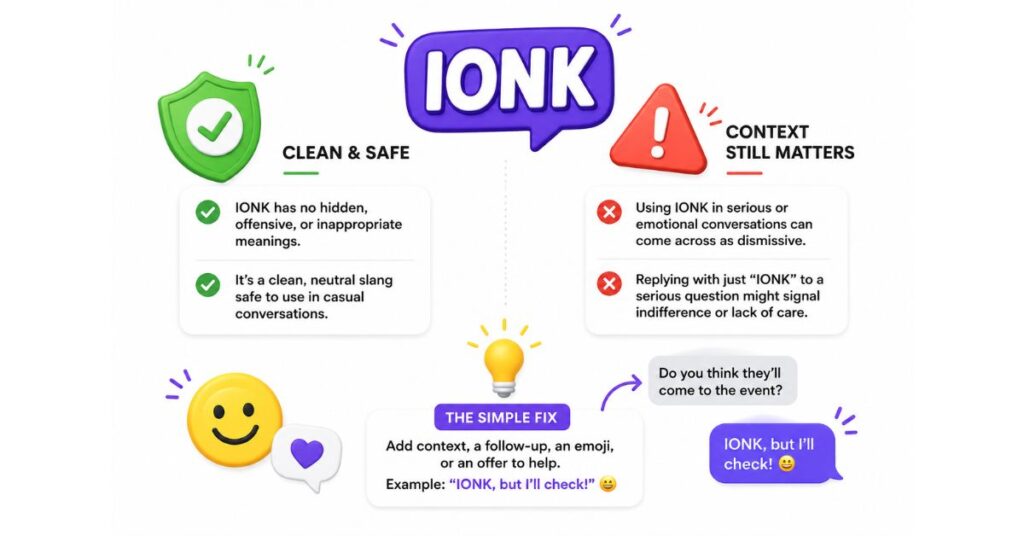
One of the refreshing things about IONK is that it carries no hidden, offensive, or inappropriate meanings. It is a clean, neutral piece of slang that is safe to use in casual contexts.
That said, context still matters. Using IONK in emotionally charged or serious conversations can come across as dismissive, even if that is not the intent. For example, replying to a serious question with just “IONK” might signal indifference or a lack of care.
The simple fix is adding context, a follow-up sentence, an emoji, or an offer to help (“IONK, but I’ll check!”) can completely change how the message lands.
Suitability for Professional Communication
IONK is not appropriate for professional settings. In business emails, formal Slack channels, client communications, or workplace messages, this type of slang creates two problems: it looks unprofessional, and it may be misunderstood entirely.
Instead of typing “IONK the deadline,” use clear and complete language: “I’m not sure about the deadline, but I’ll confirm and get back to you shortly.”
Professional communication values clarity over speed. Even IDK pushes the boundaries in a workplace context, IONK is further still. Stick to full sentences and standard phrasing when professionalism is required.
What Does IONK Mean in Text?
To put it plainly: IONK means “I don’t know” in text messages and online chats. It is a phonetic slang term, meaning it is spelled the way it sounds when spoken out loud quickly. This is different from most abbreviations, which use the first letters of each word.
It works best in fast, informal exchanges where a short reply keeps the conversation flowing. When someone asks what is happening and the honest answer is uncertainty, IONK delivers that message quickly, casually, and with a touch of personality.
The Origin and Evolution of IONK Slang
IONK evolved organically from the phonetic trends in digital communication. Unlike IDK, which is a straightforward initial abbreviation, IONK captures the sound of the phrase rather than just its letters. Say “I don’t know” quickly and casually, the blurred “I-on-k” sound is exactly where the slang comes from.
As platforms like TikTok rewarded short, punchy language in captions and comments, phonetic slang terms found the perfect environment to thrive. Influencers and everyday users alike incorporated IONK into their content, accelerating its spread across the internet.
Over time, it grew from a niche shorthand into a recognizable part of Gen Z digital vocabulary used in everything from meme reactions to story replies.
How to Use IONK in Conversation
Using IONK correctly is mostly about reading the room. Here are some practical guidelines:
- Use it when you are genuinely unsure. IONK communicates honest uncertainty without over-explaining.
- Pair it with an emoji for warmth. “IONK” feels friendlier than a bare “IONK” with no context.
- Add a follow-up when helpful. “IONK, but let me find out!” shows effort even while admitting uncertainty.
- Skip it in formal or sensitive conversations. IONK is casual by design it does not belong in serious discussions.
- Do not overuse it. Like any slang, IONK loses impact if it becomes your default response to everything.
IONK Meaning on Social Media Platforms
Across social media, IONK is a natural fit for the fast-paced, reaction-driven culture of platforms like TikTok, Instagram, and Snapchat. Users reach for it when a meme is confusing, a trend makes no sense, or a comment needs a quick reply without much thought behind it.
The social media version of IONK is often slightly more performative it is not just admitting you do not know something, it is doing so in a relatable and sometimes comedic way. A TikTok caption that reads “IONK what I’m doing with my life” resonates because it is honest, self-aware, and funny all at once.
What Does IONK Mean In Text On Instagram
On Instagram, IONK appears most frequently in story replies, comment sections, and DMs. Users react to confusing reels, trending audio, or posts they cannot fully interpret by dropping a quick IONK in the comments.
Common Instagram usage examples:
- “Why is this going viral? IONK but same” (comment under a trending meme)
- “IONK what filter this is but it’s cute” (reply to a story)
- “IONK, maybe check the link in bio?” (DM response)
On Instagram, IONK fits into the quick-reaction culture where users want to engage with content without writing full sentences. It is casual, fast, and fits the platform’s conversational comment style.
What Does IONK Mean Snapchat
Snapchat is arguably where IONK feels most at home. The app’s design encourages fast, throwaway conversations, and IONK matches that energy perfectly.
On Snapchat, you will see IONK in:
- Quick chat replies when someone asks a question mid-streak
- Story captions expressing confusion or uncertainty
- Group chats where fast, low-effort replies are the norm
Example Snapchat exchange:
Friend: “Are you coming tonight?” You: “IONK yet, depends on how I feel lol.”
The casual and non-committal nature of IONK suits Snapchat’s informal, in-the-moment communication style. It keeps responses quick without shutting the conversation down entirely.
IONK Meaning TikTok
TikTok has played a huge role in spreading IONK to a wider audience. The platform’s comment culture favors short, punchy reactions, and IONK delivers exactly that.
You will find IONK on TikTok in several forms:
- Video captions: “IONK what’s happening here but I watched it 5 times”
- Comments: Reacting to confusing trends, dances, or announcements
- Duet and stitch reactions: Where creators show genuine confusion about a video they are responding to
TikTok’s algorithmic reach also means that once a slang term gets picked up by popular creators, it spreads fast. IONK benefited from this content creators naturally used it in captions and comment responses, and their audiences adopted it just as naturally.
IONK Meaning In Text Slang
As a piece of text slang, IONK sits within a broader ecosystem of phonetic and abbreviated expressions that have reshaped how people write online. It is part of a category that linguists sometimes call informal digital speech language that mirrors spoken conversation rather than following written grammar rules.
Other examples in this category include: “gonna” (going to), “wanna” (want to), “ion” (I don’t), and “tryna” (trying to). IONK fits naturally alongside these because it was never designed to be grammatically correct it was designed to feel real and human.
In text slang specifically, IONK signals a few things beyond just “I don’t know”: it signals casualness, familiarity with online culture, and a willingness to keep things light. That combination is why it has stuck around while many other slang terms have faded.
Common Confusions About IONK
The most frequent points of confusion around IONK include:
- IONK vs ION: These are often mixed up. ION means “I don’t” as a standalone term (“ion think so” = “I don’t think so”). IONK includes the “k” to complete the phrase “I don’t know.”
- IONK vs IDK: Same meaning, different personality. IDK is neutral; IONK is expressive and more conversational.
- “Is it a typo?” No. IONK is always intentional when used by someone familiar with the slang.
- “Does it mean something different in gaming?” The meaning stays consistent across platforms. Context might add nuance (frustration vs humor), but the base meaning is always “I don’t know.”
Similar Abbreviations and Alternatives to IONK
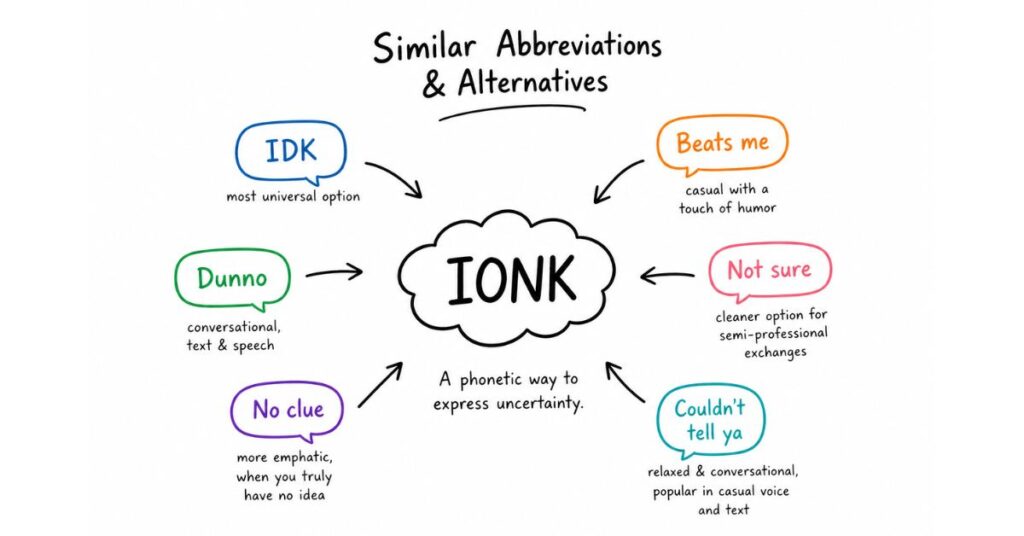
If you want to express uncertainty without using IONK, several alternatives cover the same ground:
- IDK: the most universal option, works in almost any informal context
- Dunno: conversational, works in both text and speech
- No clue: slightly more emphatic, useful when you truly have no idea
- Beats me: casual with a touch of humor
- Not sure: cleaner option for semi-professional exchanges
- Couldn’t tell ya: relaxed and conversational, popular in casual voice and text
Each carries slightly different energy. IONK still stands out for its phonetic uniqueness and the way it mirrors natural speech, something the alternatives do not quite replicate.
Why IONK Represents Modern Digital Culture
IONK is more than just a shortcut it is a small window into how communication has changed in the age of social media. Language is adapting to the demands of digital life: faster, more expressive, and less constrained by formal rules.
Slang like IONK reflects three core values of modern online culture:
- Speed: Four letters deliver a full thought in under a second.
- Authenticity: Phonetic slang sounds human because it mirrors real speech patterns.
- Community: Using current slang signals familiarity with a group’s language and culture.
Just as LOL and IDK became permanent fixtures of internet vocabulary, IONK is carving out its own space. Whether it becomes a long-term staple or eventually gets replaced by something newer, it is a meaningful snapshot of how Gen Z is actively reshaping English in real time.
Frequently Asked Questions
What does IONK mean in a text message?
IONK means “I don’t know.” It is casual slang used in informal conversations to express uncertainty quickly and naturally.
Is IONK the same as IDK?
They have the same meaning but different tones. IDK is neutral and universal, while IONK feels more expressive, playful, and conversational.
Can I use IONK in professional messages?
No. IONK is informal slang and is not appropriate for workplace emails, formal chats, or professional communication. Use “I’m not sure” or “I’ll check on that” instead.
Where did IONK come from?
IONK originated from phonetic texting trends in the early 2010s, growing in popularity as platforms like Snapchat and TikTok made short, casual language the norm.
Is IONK offensive or inappropriate?
No. IONK carries no hidden or offensive meanings. It is a safe, neutral slang term, though using it in serious or sensitive conversations may come across as dismissive.
Conclusion
Understanding IONK meaning in text is simpler than it looks. It means “I don’t know,” and it belongs to the growing world of phonetic internet slang that makes digital conversations feel more natural and human.
Whether you spot it on TikTok, Snapchat, Instagram, or in a group chat, IONK is always used to express uncertainty in a casual, low-pressure way. It fits perfectly into the fast-paced rhythm of modern online communication, especially among younger users who value brevity and personality in equal measure.
Use IONK freely with friends and in informal digital spaces. But when professionalism matters, keep it out of the message and opt for clear, complete language instead. Knowing when to use slang and when not to is the real mark of digital communication intelligence.

I’ve been working in content writing since 2021 across multiple niches, with a strong focus on simplifying complex topics. On Maghints, I break down slang meanings, abbreviations, and internet terms clearly and simply so they’re easy to understand. My goal is to make modern online language simple and accessible for everyone.