

Have you ever stopped mid-sentence, wondering whether to write journeys or journies? You are not alone. This is one of the most searched spelling questions in English grammar, and the answer is simpler than you think. The correct plural form is always journeys, and once you understand why, you will never second-guess it again.
In this guide, we break down the grammar rule behind the correct spelling, compare real-life examples, explore the meaning and synonyms of the word, and explain why getting this right matters for your writing. Whether you are a student, a blogger, or a professional, this article will make the rule stick.
The Plural Form of “Journey”
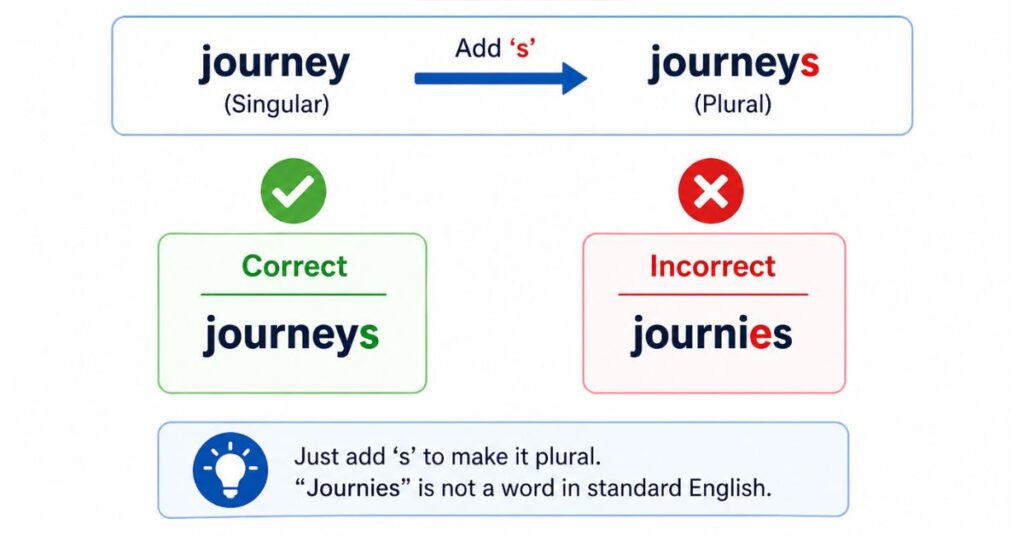
The word journey refers to the act of traveling from one place to another. It can describe a physical trip across a country or an abstract experience of personal growth. In both cases, the plural form works the same way.
To make journey plural, you simply add the letter s to the end: journeys.
| Form | Example |
| Singular | She went on a long journey through the mountains. |
| Plural | Their journeys across three continents changed their lives. |
The form journies does not exist in standard English. It is not accepted by Merriam-Webster, Oxford, or Cambridge dictionaries. It is simply a misspelling caused by applying the wrong grammar rule.
Journeys or Journies Plural
When asking about the plural of journey, the answer is clear-cut: journeys is always correct, and journies is always wrong.
The confusion arises from a half-remembered grammar rule that many people apply incorrectly. Some writers assume that every noun ending in the letter y must change that y to i before adding es. But that is only half the rule and the half that does not apply to journey.
The full rule depends on what letter comes before the y. In the word journey, the letter before y is e, which is a vowel. That single fact changes everything.
Why “Journies” Is Incorrect
The spelling journies is incorrect because it applies a rule meant for a completely different category of words. Writers who write journies are thinking of words like baby → babies or city → cities. In those words, a consonant comes before the y, so the y changes to i and es is added.
Journey does not belong to that category. It ends in ey, not a consonant + y. So the y stays exactly where it is, and only an s is added. The result is journeys, not journies.
Think of it this way: would you ever write keies instead of keys? Or toies instead of toys? No, and the same logic applies to journey.
The Vowel Before Y Rule
This is the rule that governs the plural of journey:
When a noun ends in a vowel followed by the letter y, simply add s to form the plural. Do not change the y.
| Singular | Plural | Vowel Before Y? |
| Journey | Journeys | Yes (e) |
| Monkey | Monkeys | Yes (e) |
| Valley | Valleys | Yes (e) |
| Key | Keys | Yes (e) |
| Boy | Boys | Yes (o) |
| Toy | Toys | Yes (o) |
All of these words follow the same pattern. The vowel before y signals that you only need to add s, no changes to the base word are required.
The Consonant Before Y Rule
On the other side of this rule are words where a consonant comes before the y. In these cases, the y is replaced with i, and es is added.
| Singular | Plural | Consonant Before Y? |
| City | Cities | Yes (t) |
| Baby | Babies | Yes (b) |
| Party | Parties | Yes (t) |
| Story | Stories | Yes (r) |
| Country | Countries | Yes (r) |
Notice how journey fits none of these. It’s y follows the vowel e, placing it firmly in the first group, the add s group.
Quick memory tip: Vowel before y → add s. Consonant before y → change to ies.
Journeys or Journies in English
In both British English and American English, the correct plural is journeys. There is no regional variation here. Whether you are writing for a UK audience or a US publication, the spelling rule stays exactly the same.
This is worth noting because some spelling differences do exist between the two variants of English, for example, colour vs. color, or travelling vs. traveling. But journeys is universally consistent. No English-speaking country accepts journies as a valid plural form.
If you come across journies in a published piece, it is most likely a typo or an uncorrected error. Reputable style guides, dictionaries, and grammar references all confirm journeys as the one and only correct form.
Key Examples for Comparison
Here is a side-by-side look at the two groups of nouns ending in y to cement the rule in your memory:
| Vowel + Y → Add “s” | Consonant + Y → Change to “ies” |
| Journey → Journeys | Baby → Babies |
| Valley → Valleys | City → Cities |
| Monkey → Monkeys | Party → Parties |
| Key → Keys | Story → Stories |
| Boy → Boys | Country → Countries |
Every time you see journey, place it in the left column. It will always land there.
Literal and Metaphorical Journeys
The word journeys is used in two major contexts, both of which are common in everyday writing.
Literal Journeys
Literal journeys refer to physical travel from one place to another. These can be short or long, planned or spontaneous. Travel writers, historians, and journalists frequently use the word in this sense.
Examples:
- “The explorers documented their journeys through the Amazon in detailed field notes.”
- “Road journeys across the American Southwest inspired her first novel.”
- “The ship’s log recorded all the voyages and journeys taken over three decades.”
Journeys or Journies Meaning
The word journey (plural: journeys) carries two layers of meaning in English:
Literal meaning: An act of traveling from one location to another, especially over a significant distance or period of time.
Figurative meaning: A process of personal development, change, or transformation. This can include emotional growth, spiritual development, career progression, or recovery from hardship.
Both meanings are widely accepted and used. The plural journeys applies equally to both.
Metaphorical Journeys
In literature, motivational writing, and personal essays, journeys is frequently used to describe life experiences rather than physical travel. Authors use it to give weight and meaning to processes that unfold over time.
Examples:
- “The documentary followed the emotional journeys of three families rebuilding after loss.”
- “Her journeys through self-doubt and rediscovery are captured honestly in the memoir.”
- “Leadership journeys rarely follow a straight path.”
Journeys or Journies Synonym
If you want to vary your language or avoid repeating journeys too often in your writing, here are some strong synonyms:
| Synonym | Best Used For |
| Trips | Short or casual travel |
| Voyages | Sea or long-distance travel |
| Expeditions | Scientific or adventurous travel |
| Treks | Long, often difficult journeys on foot |
| Odysseys | Epic, transformative journeys |
| Quests | Goal-driven or symbolic journeys |
| Tours | Organized or sightseeing travel |
| Travels | General movement across places |
| Adventures | Exciting, unpredictable journeys |
Using these synonyms adds variety and depth to your writing, especially in travel writing, fiction, or personal essays. They also carry different connotations. A voyage feels more formal than a trip, while an odyssey implies something deeply meaningful.
Common Grammar Mistakes in Plural Forms
The journeys/journies confusion is part of a broader pattern of plural spelling errors in English. Here are some other common mistakes:
| Incorrect | Correct | Rule |
| Journies | Journeys | Vowel before y → add s |
| Valeys | Valleys | Vowel before y → add s |
| Monkeies | Monkeys | Vowel before y → add s |
| Babys | Babies | Consonant before y → change to ies |
| Boxs | Boxes | Words ending in x → add es |
| Knifes | Knives | Irregular: fe → ves |
Understanding these patterns as a group rather than memorizing each word alone makes it far easier to get them right consistently.
How to Avoid These Mistakes
The most reliable way to avoid plural spelling errors is to build a habit of checking the letter that comes before the y in any word you want to pluralize.
Ask yourself: Is it a vowel or a consonant?
- Vowel → add s
- Consonant → change y to ies
Beyond that, keeping a short reference list of words you frequently misspell and reviewing them regularly is one of the most practical grammar tips for writers. Proofreading your work before publishing even a quick read-through catches the majority of these errors before they reach your readers.
Real-Life Examples of “Journeys” in Writing

Career Journeys
In professional and business writing, career journeys describes the path a person takes through their working life, the roles, transitions, and growth they experience over time.
Example: “The conference brought together professionals to share their career journeys and the pivotal decisions that shaped them.”
Spiritual Journeys
In religious, philosophical, and wellness writing, spiritual journeys refers to the inner pursuit of meaning, faith, or transformation.
Example: “Many pilgrims describe their spiritual journeys as life-changing experiences that bring clarity and peace.”
Emotional Journeys
In literature and psychology, emotional journeys captures the internal experience of characters or individuals as they move through significant life events.
Example: “The film portrays the emotional journeys of three siblings coming to terms with their father’s illness.”
Practical Usage Tip
Here is the single most useful tip you can take from this article:
If you are ever unsure between journeys and journies, look at the two letters before the s: they are ey. A vowel before y means you only add s. It will always be journeys.
This applies whether you are describing physical travel, personal growth, career paths, or fictional adventures. The plural never changes form.
Spelling Rules for Plural Forms
Here is a complete reference table for the most common English pluralization rules:
| Rule | Singular | Plural | More Examples |
| Add “s” | Dog | Dogs | Cat → Cats |
| Add “es” | Box | Boxes | Tomato → Tomatoes |
| Vowel + y → add “s” | Journey | Journeys | Monkey → Monkeys |
| Consonant + y → ies | City | Cities | Party → Parties |
| Irregular: fe → ves | Knife | Knives | Leaf → Leaves |
| No change | Deer | Deer | Sheep → Sheep |
How to Spell Journeys or Journies
The correct spelling is J-O-U-R-N-E-Y-S. Break it down like this:
- Start with the base word: journey
- Check the ending: it ends in ey (vowel + y)
- Apply the vowel-before-y rule: just add s
- Result: journeys
There is no version of this process that produces journies. The i has no place in this word’s plural form. If your spell-checker flags journies, that is the correct response replace it immediately with journeys.
Why Accurate Pluralization Matters
Clarity in Communication
When readers encounter journies instead of journeys, they notice it even briefly. That moment of hesitation breaks the reading flow and distracts from your message. Correct spelling keeps your reader focused on what you are saying, not how you are saying it.
Professionalism in Writing
In professional contexts, business emails, reports, academic papers, job applications small spelling errors signal a lack of attention to detail. A single misspelling like journies can make a reader question the overall quality of your work, even if everything else is strong.
Real-Life Impact
Grammar errors have measurable consequences. Editors reject manuscripts that show consistent carelessness. Employers notice poorly written applications. Blog readers lose trust in content that contains avoidable mistakes. Accuracy in writing is not pedantry it is professionalism.
Tips to Improve Your Writing Accuracy
Improving spelling and grammar is a gradual process, but a few habits make a significant difference:
- Learn rules in groups: Understanding all vowel-before-y words together is more efficient than memorizing journeys alone.
- Read widely: Exposure to well-edited writing reinforces correct usage naturally over time.
- Proofread everything: Even experienced writers make errors in first drafts. A second pass catches most of them.
- Use trusted references: Merriam-Webster and Oxford Online are reliable, free tools for verifying spelling instantly.
- Write deliberately: Slowing down when you know a word is tricky reduces the chance of error.
Understanding Why “Journeys” Is the Correct Spelling
The root of journey goes back to the Old French word journée, meaning a day’s work or travel, which in turn traces to the Latin diurnum (day). Historically, a journey described exactly how far one could travel in a single day. Over time, the meaning expanded to include any significant travel or life experience.
Throughout this evolution, the spelling of the plural remained consistent: journeys. No historical form of the word produced journies. The error is entirely modern and entirely avoidable.
How “Journies” Became a Common Mistake
The misspelling journies entered common usage as English education expanded and more people began writing independently. Without a firm grasp of the two separate rules for nouns ending in y, many writers generalized the more commonly taught rule, consonant + y → ies, and applied it everywhere.
Words like baby → babies, city → cities, and story → stories are taught early and reinforced frequently. For learners who encountered these words first, the pattern became a default. When they later encountered a journey, they applied the same transformation without checking whether it applied.
The fix is simple: once you know that the journey ends in a vowel before y, the correct plural becomes obvious and permanent.
Examples of Journeys in Literature and Life

Great writers have always used journeys to capture both physical and spiritual movement:
- In The Odyssey, Homer builds an entire epic around the journeys of Odysseus physical crossings of seas and spiritual trials of character.
- Dante’s Divine Comedy is structured as a series of journeys through Inferno, Purgatorio, and Paradiso.
- In Invisible Cities by Italo Calvino, journeys become a framework for exploring imagination and memory.
- In everyday life, we speak of health journeys, recovery journeys, and learning journeys, each one an honest use of a word with deep roots in human experience.
In every one of these cases, the plural is journeys. Literature confirms what grammar teaches.
Why Correct Pluralization Improves Professionalism
The difference between journeys and journies is one letter. But that one letter carries weight. Readers who know the correct form will notice the error; readers who do not know will simply absorb it uncritically, spreading the mistake further.
Writers who get this right signal something important: they care about language, they check their work, and they respect their readers. In competitive fields publishing, journalism, corporate communications, and academia, that kind of attention to detail sets strong writers apart from careless ones.
Frequently Asked Questions
Is “journies” ever correct in any form of English?
No. Journies is not recognized as correct in British English, American English, or any other standard variety. The only accepted plural is journeys.
What is the easiest way to remember “journeys” is correct?
Think of the word key → keys. Just like key ends in a vowel before y and becomes keys, journey ends in a vowel before y and becomes journeys.
Can “journeys” be used as a verb?
Yes. Journey can function as a verb, meaning “to travel.” “We journeyed across the desert for three days.” The third-person singular present tense is journeys: “She journeys far from home each year.”
What are the best synonyms for “journeys” in formal writing?
In formal writing, strong alternatives include voyages, expeditions, travels, and odysseys, depending on the context and tone you want to convey.
Does the same vowel-before-y rule apply to verbs?
Yes. For verbs, the same principle applies. Journey → journeys (third person singular) follows the same rule as the plural noun. Words like play → plays and enjoy → enjoys follow the same vowel-before-y pattern.
Conclusion
The answer to the question journeys or journies is clear, consistent, and grounded in a straightforward grammar rule. Journeys is always correct. Journies is always wrong.
The rule is simple: when a noun ends in a vowel followed by y, you add s to form the plural. No change to the y, no added i, no complication. Journey ends in ey, a vowel followed by y, so its plural is journeys full stop. Understanding this rule does more than fix one word. It gives you a framework for pluralizing an entire category of English nouns correctly. Whether you are describing literal journeys across continents or metaphorical journeys through life, you can now write with confidence, clarity, and accuracy. That is, after all, what every good writing journey is about.

I’ve been working in content writing since 2021 across multiple niches, with a strong focus on simplifying complex topics. On Maghints, I break down slang meanings, abbreviations, and internet terms clearly and simply so they’re easy to understand. My goal is to make modern online language simple and accessible for everyone.