

You’re scrolling through your messages, and someone ends their request with “TIA.” You pause. Is it a name? An abbreviation? Slang?
You’re not alone. Thousands of people search for the meaning of TIA every week. This article gives you the complete answer to the texting meaning, medical meaning, Spanish meaning, and everything in between.
What Does TIA Mean in Text? (Quick Meaning)
TIA stands for “Thanks In Advance.”
It’s a polite abbreviation used at the end of a request to show gratitude before someone responds or helps. Instead of writing the full phrase, people shorten it to save time while still sounding courteous.
Quick examples:
- “Can you send me the file? TIA.”
- “Any good restaurant suggestions? TIA!”
- “Let me know if tomorrow works. TIA”
At its core, TIA combines politeness with efficiency, two things modern digital communication values most.
TIA Acronym Meaning
TIA is an acronym, not a word. Each letter stands for something:
- T – Thanks
- I – In
- A – Advance
It belongs to the same family as LOL, BRB, and FYI abbreviations that became standard in digital communication. The full phrase it replaces is “Thanks in advance,” which people used in professional emails long before texting existed.
Unlike slang, acronyms carry fixed meanings. TIA is recognized globally across texts, emails, forums, and social media.
TIA Meaning Medical
In medical settings, TIA stands for Transient Ischemic Attack, commonly called a “mini-stroke.”
A TIA occurs when blood flow to part of the brain is temporarily blocked. Symptoms are similar to a stroke, sudden weakness, slurred speech, or vision problems, but they usually resolve within minutes to a few hours, leaving no permanent damage. However, doctors treat it as a serious warning sign because a full stroke may follow.
Key facts about TIA in medicine:
- Symptoms typically last minutes, not hours
- It is considered a medical emergency
- It does not cause permanent brain tissue death
- It is often a warning signal for future stroke risk
If you ever see TIA in a medical report or conversation with a doctor, it has nothing to do with texting; it refers to this neurological condition.
TIA Meaning Spanish
In Spanish, tía (with an accent over the í) means “aunt.”
It is a common family term used throughout Spanish-speaking countries. The accent mark is the key difference: “tía” is Spanish for aunt, while “TIA” in all caps is the English texting acronym.
If someone texts you “mi tía llega mañana,” they are saying their aunt is arriving tomorrow, not thanking you in advance.
Quick reference:
- TIA (English, caps) = Thanks In Advance
- tía (Spanish, accent) = Aunt
Origin & Background of TIA
TIA did not start as internet slang. Its roots go back to formal email and office communication in the late 1990s and early 2000s, when people wanted a polite, quick way to close a request.
How It Evolved
| Era | Where TIA Was Used |
| Late 1990s | Professional emails and office memos |
| Early 2000s | Online forums and tech communities |
| 2010s | SMS texting and Facebook messages |
| Today | WhatsApp, Instagram DMs, TikTok, Slack |
As platforms evolved, TIA moved from formal to casual settings. The meaning stayed the same, but the tone became more flexible, sometimes warm, sometimes direct, sometimes even passive-aggressive, depending on how it is used.
Real-Life Conversations Using TIA
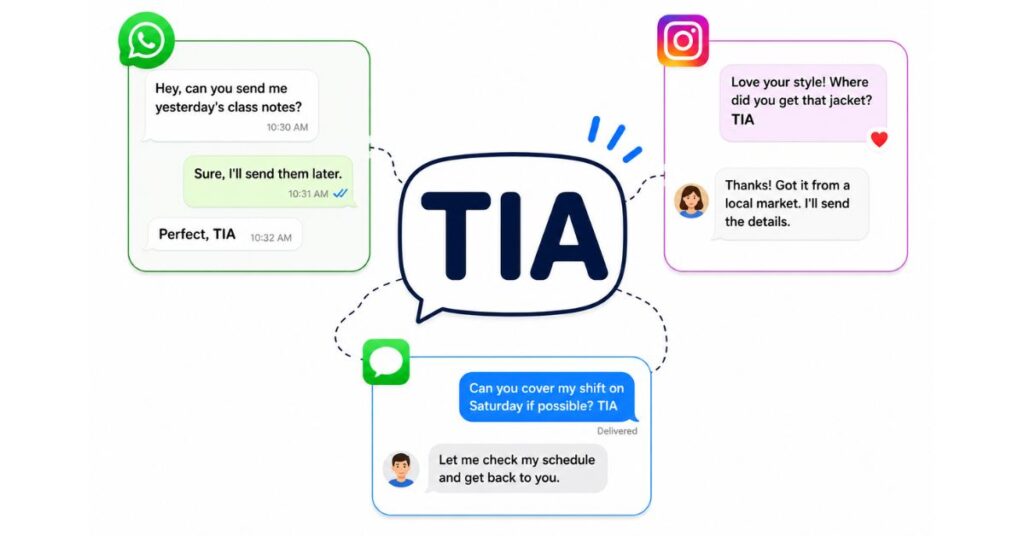
WhatsApp Chat
| Person A: Hey, can you send me yesterday’s class notes? | Person B: Sure, I’ll send them later. | Person A: Perfect, TIA |
Instagram DMs
| Person A: Love your style! Where did you get that jacket? TIA | Person B: Thanks! Got it from a local market. I’ll send the details. |
Text Message
| Person A: Can you cover my shift on Saturday if possible? TIA | Person B: Let me check my schedule and get back to you. |
These examples show that TIA works best when paired with a polite request and a warm tone.
Emotional & Psychological Meaning of TIA
On the surface, TIA is just gratitude. But underneath, it carries social signals worth understanding.
What It Signals Emotionally
- Efficiency: The sender values time but still wants to sound respectful
- Confidence: It subtly assumes the person will help
- Social warmth: With emojis, it feels friendly and appreciative
- Mild pressure: Without context, it can feel slightly presumptive
Psychologically, saying “thanks in advance” creates a soft social obligation. The recipient has already been thanked, which can make them more likely to respond positively. This is why TIA is so effective and why it can occasionally feel pushy in the wrong context.
Usage of TIA in Different Contexts
Social Media
TIA is very common in captions, comment sections, and community posts where people ask for recommendations, advice, or information.
Example: “Best budget headphones under $50? TIA”
TIA Meaning Facebook
On Facebook, TIA frequently appears in group posts, Marketplace listings, and comment threads. Sellers use it after listing buyer guidelines. Community members use it when asking neighbors for recommendations.
Example: “Does anyone know a reliable plumber in this area? TIA!”
Friends & Relationships
Between friends, TIA feels casual and natural. It works well for small favors and quick requests. Adding an emoji or exclamation point keeps it warm rather than demanding.
Work or Professional Settings
TIA is acceptable in casual workplace emails and team chats, but should be used carefully. In formal or sensitive communication, spell out the full phrase: “Thank you in advance.”
Casual vs Serious Tone
- Casual: “Need movie suggestions, TIA!”
- Serious/Professional: “Please submit the report by Friday. TIA.”
The same abbreviation reads very differently depending on punctuation, emojis, and context.
Common Misunderstandings About TIA
Thinking It’s Rude by Default
TIA is not rude. It becomes abrupt only when the request itself sounds demanding. Adding warmth, a please, a smile emoji, or friendly wording makes a big difference.
Using It in Emotional Situations
TIA works for practical requests, not emotional conversations. “I’m going through something difficult. TIA.” does not fit. Save TIA for tasks, favors, and information requests.
Assuming It Fits Every Context
TIA is informal. It does not belong in formal documents, academic submissions, or official communications. Read the room before using it.
Believing It’s Slang
TIA is not slang. Slang is informal language tied to culture and era. TIA is a long-standing abbreviation that predates social media by years. It is as established as “FYI” or “ASAP.”
TIA Meaning Slang
While TIA is not technically slang, people sometimes use it in a sarcastic or ironic way online, especially in passive-aggressive messages. “Maybe read the instructions next time. TIA.” Here, TIA sounds sharp rather than polite. The word is the same; the tone changes everything.
Comparison Table: TIA vs Similar Terms
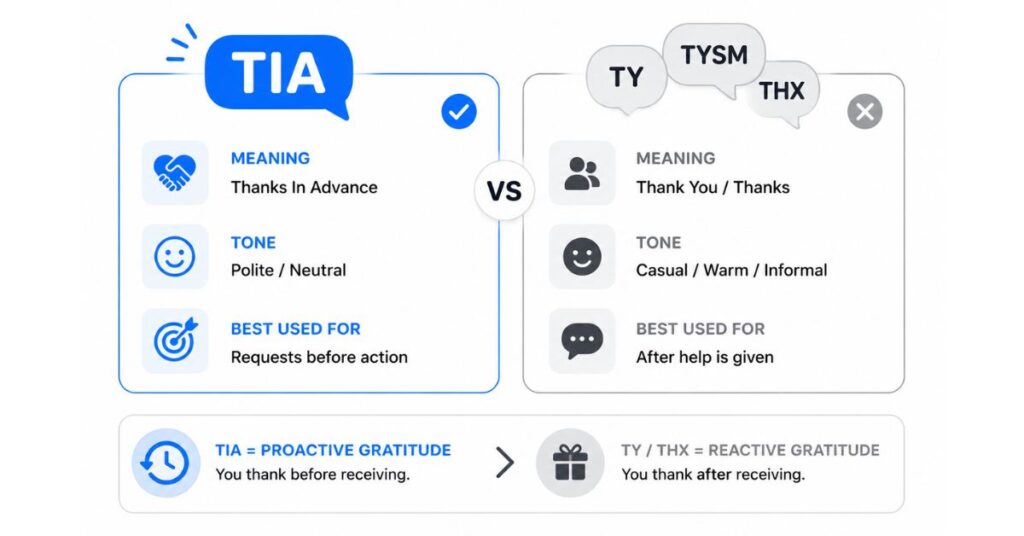
| Term | Meaning | Tone | Best Used For |
| TIA | Thanks In Advance | Polite / Neutral | Requests before action |
| TY | Thank You | Casual | After help is given |
| TYSM | Thank You So Much | Warm | Emotional appreciation |
| THX | Thanks | Quick / Informal | Casual acknowledgment |
| Appreciate it | Gratitude expression | Mature | Professional settings |
| Please | Polite request | Neutral | Any setting |
Key insight: TIA is proactive gratitude you thank before receiving. TY and THX are reactive, you thank after receiving.
Variations & Types of TIA (9 Common Forms)
- TIA: Classic, neutral usage
- TIA!: Enthusiastic or urgent
- TIA: Warm and friendly
- TIA: Respectful and sincere
- TIA: Personal or affectionate
- tia: Lowercase, relaxed and casual (popular with Gen Z)
- TIA, appreciate it: More complete and balanced
- Thanks in advance: Full written-out version for formal use
- Big TIA: Humorous or exaggerated online style
Each variation shifts the emotional weight of the message slightly.
How to Respond When Someone Uses TIA
Casual Replies
- “Sure, no problem!”
- “Got you.”
- “On it!”
Funny Replies
- “Advance thanks accepted.”
- “The TIA worked on me, sending now.”
Mature / Confident Replies
- “I’ll look into it and get back to you.”
- “Happy to help give me a moment.”
Private or Respectful Replies
- “Of course, I’ll handle it shortly.”
- “Thank you for the kind message. I’ll follow up soon.”
Regional & Cultural Usage of TIA
Western Culture
In the US, UK, Canada, and Australia, TIA is widely recognized and regularly used in texts, Reddit posts, Facebook groups, and office emails. It is considered efficient and politely casual.
Asian Culture
Among younger internet users in Asian countries, TIA is increasingly common in English-language chats and student communities. However, more formal or complete expressions of gratitude are often preferred in professional settings.
Middle Eastern Culture
TIA appears mainly among English-speaking younger users and professionals in Middle Eastern countries. In formal business contexts, the full phrase “thank you in advance” is generally preferred.
Global Internet Usage
Social media has made TIA a universal shorthand. Whether someone is in Pakistan, Brazil, or Japan, if they spend time in English online communities, they likely know what TIA means. It travels with internet culture.
TIA Name Meaning
As a given name, Tia is of Greek and Spanish origin, generally meaning “aunt,” “goddess,” or “princess.” It is also considered a short form of names like Leticia, Portia, or Cynthia. In the US and UK, Tia is used as a standalone first name for girls, independent of its Spanish or acronym meanings.
Frequently Asked Questions
What does TIA mean?
TIA most commonly means “Thanks In Advance,” a polite abbreviation used in texts, emails, and social media to show appreciation before someone helps.
What does TIA mean in Medical Terms?
In medicine, TIA stands for Transient Ischemic Attack, a temporary blockage of blood flow to the brain, often called a mini-stroke. It is a medical emergency and a warning sign for future stroke risk.
What does TIA mean in Spanish?
In Spanish, tía means “aunt.” It is written with an accent mark (tía) to distinguish it from the English acronym TIA.
What does TIA mean in Texting?
In texting, TIA means “Thanks In Advance.” It is placed at the end of a request to express polite gratitude before the other person responds or helps.
What does TIA mean on Facebook?
On Facebook, TIA means “Thanks In Advance.” It is commonly used in group posts, Marketplace listings, and comment threads when asking for recommendations, help, or cooperation from other users.
Conclusion
So, what does TIA mean in text?
Most of the time, it means “Thanks In Advance,” a simple, widely used abbreviation that adds politeness to any request without taking up extra time. But as this article shows, TIA also carries medical weight as a Transient Ischemic Attack and a personal meaning as the Spanish word for aunt.
Understanding context is everything. The same three letters can sound warm, professional, sarcastic, or urgent depending on tone, platform, and relationship.
Use TIA thoughtfully. Pair it with warmth when the situation calls for it, spell it out when the context is formal, and always consider how the other person might read it. Good communication is never just about the words; it’s about how those words land.

I’ve been working in content writing since 2021 across multiple niches, with a strong focus on simplifying complex topics. On Maghints, I break down slang meanings, abbreviations, and internet terms clearly and simply so they’re easy to understand. My goal is to make modern online language simple and accessible for everyone.