

You’re in the middle of a text conversation when someone suddenly replies with “IDM.” You pause. What does that even mean? Is it rude? Is it agreeable? Should you be offended?
Don’t worry, you’re not alone. Millions of people search for IDM meaning in text every single day. This short guide breaks everything down clearly, so you never feel confused again.
What Does IDM Mean?
At its core, IDM stands for “I Don’t Mind.” It’s a casual, polite way of saying you’re okay with a suggestion, open to an idea, or have no strong preference either way.
Think of it as the texting version of “whatever works for me” but without sounding dismissive. IDM carries a relaxed, cooperative tone that keeps conversations smooth and stress-free.
Quick examples:
- “Pizza or burgers?” → “IDM, you pick.”
- “Can we meet at 5 instead of 4?” → “IDM, that works.”
- “Do you mind if I borrow your notes?” → “IDM at all.”
In every case, IDM signals flexibility and a laid-back attitude.
IDM Meaning Slang
In modern internet slang, IDM is widely used across WhatsApp, Instagram DMs, Snapchat, gaming chats, and TikTok comment sections. It belongs to the same family of chat acronyms as IDK (I don’t know), IDC (I don’t care), and IMO (in my opinion).
As a slang term, IDM reflects a personality trait many Gen Z users value: being easygoing and low-pressure in conversations. It’s not just shorthand, it’s a social signal that says “I’m chill, you decide.”
What Does IDM Mean in Text
In a text message, IDM is used when someone wants to express agreement or neutral acceptance without writing a long reply. It’s one of the most efficient ways to respond when you genuinely have no preference.
The tone of IDM in text depends heavily on context. Among close friends, it sounds warm and relaxed. In a flat, one-word reply during a serious conversation, it can feel slightly distant. Adding a follow-up word or emoji (“IDM, either is great!”) instantly makes it warmer.
Origin and Background of the Term
IDM emerged from the early 2000s instant messaging culture, think MSN Messenger, AOL Instant Messenger, and early SMS texting. Back then, character limits and slow keyboards pushed people to abbreviate common phrases.
“I Don’t Mind” became IDM because it was short, clear, and emotionally neutral. Over time, it migrated from personal messages to group chats, comment sections, and social media platforms. Linguists note that acronyms like IDM represent how digital communication reshaped language, making it faster, more efficient, and surprisingly expressive with just three letters.
How IDM Is Used in Daily Life
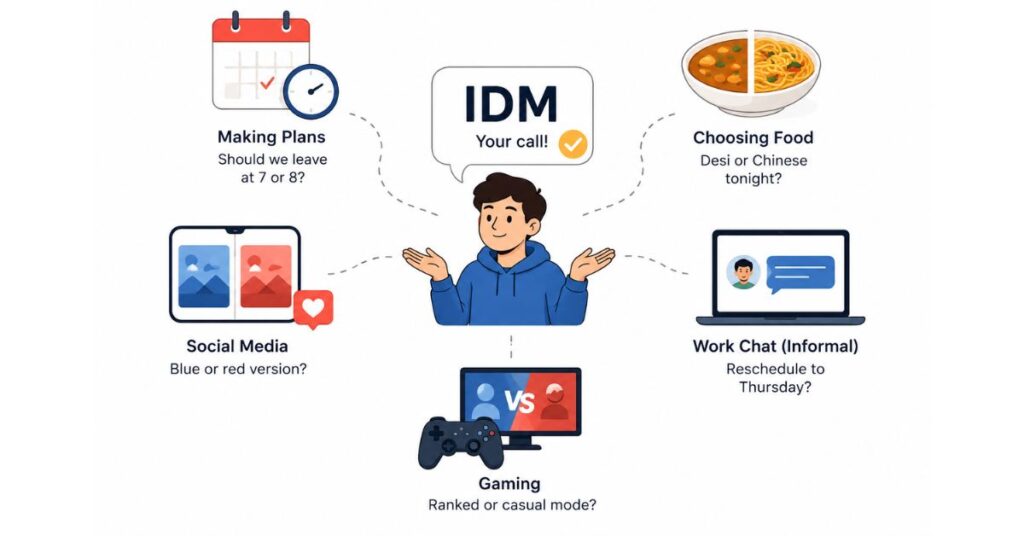
IDM appears in everyday conversations more often than you’d think. Here are some common scenarios:
- Making plans: “Should we leave at 7 or 8?” → “IDM, your call.”
- Choosing food: “Desi or Chinese tonight?” → “IDM, both sound good.”
- Social media replies: “Should I post the blue or red version?” → “IDM, both look great.”
- Work chats (informal): “Is it okay to reschedule to Thursday?” → “IDM, that works for me.”
- Gaming: “Ranked or casual mode?” → “IDM, you choose.”
Notice the consistent pattern IDM always conveys flexibility, neutrality, or calm agreement.
Emotional or Practical Meaning of IDM
IDM is more than just a shortcut. It reflects a broader communication attitude: the willingness to go with the flow without making others feel pressured.
Practically, it prevents minor decision-making from becoming a back-and-forth argument. Emotionally, it signals respect for the other person’s preference. Instead of insisting on your choice, you hand them the deciding power, which, in everyday relationships, builds trust and reduces friction.
However, overusing IDM can sometimes send an unintended message. If someone asks a question they genuinely care about, a flat “IDM” might feel like you’re not engaged. Pairing it with a follow-up thought makes all the difference.
Similar or Related Terms
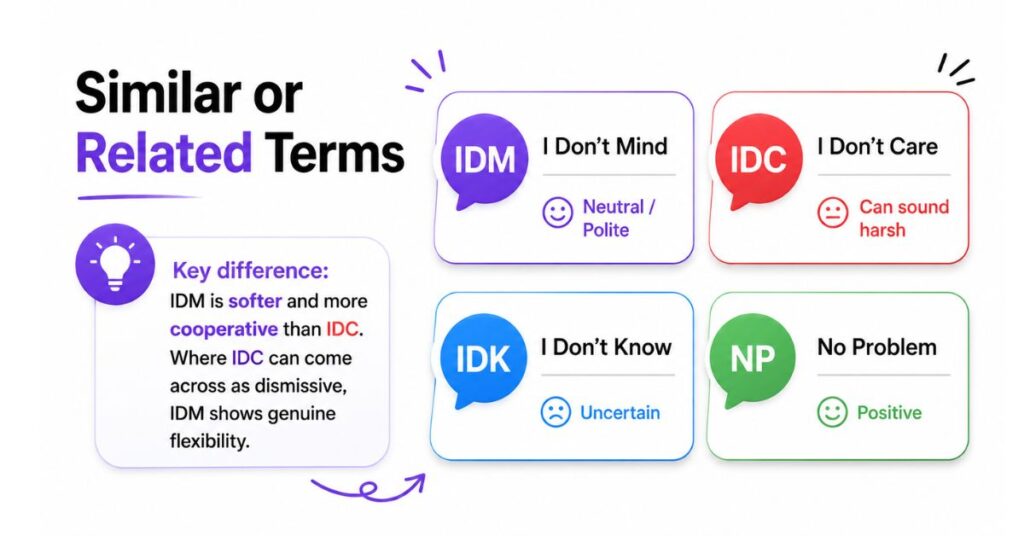
Understanding related acronyms helps you pick the right word for the right moment.
| Acronym | Full Form | Tone |
| IDM | I Don’t Mind | Neutral / Polite |
| IDC | I Don’t Care | Can sound harsh |
| IDK | I Don’t Know | Uncertain |
| IMO | In My Opinion | Expressive |
| TBH | To Be Honest | Candid |
| NP | No Problem | Positive |
Key difference: IDM is softer and more cooperative than IDC. Where IDC can come across as dismissive, IDM shows genuine flexibility.
Common Misunderstandings About IDM
Even popular acronyms get misread. Here are the most common misconceptions:
- “IDM means I don’t care”: False. IDM = I Don’t Mind, which is noticeably more polite and considerate than IDC.
- “Only teenagers use IDM”: Not true. Professionals, adults, and people of all ages use it in informal digital conversations.
- “It’s always passive-aggressive”: Rarely. Most people use it simply because it’s quick to type, not to hide frustration.
- “IDM is universal”: Mostly in English-speaking contexts. Non-native speakers may find it unfamiliar, so spelling it out is safer in cross-cultural chats.
Examples of IDM in Sentences
Here’s how IDM flows naturally in real conversations:
- “IDM, which restaurant we go to you pick.”
- “If you want to start at 3 or 4, IDM either way.”
- “IDM about the color scheme, both look clean.”
- “We can take the train or drive IDM.”
- “IDM helping out, just let me know the time.”
- “Should we watch a comedy or a thriller? IDM.”
- “IDM is waiting a few minutes if you’re running late.”
- “You choose the playlist IDM that we listen to.”
What Does IDM Mean on Snapchat
On Snapchat, IDM carries the exact same meaning: “I Don’t Mind.” Because Snapchat conversations move fast streaks, quick replies, story responses, and short acronyms like IDM fit perfectly into the platform’s communication style.
You’ll most often see it in response to casual questions: “Can I post this snap of you?” → “IDM.” It signals relaxed, low-pressure permission or agreement, which is very on-brand for Snapchat’s casual social tone.
What Does IDM Mean on Instagram
On Instagram, IDM appears in DMs, comment replies, and group chats. The meaning stays consistent, “I Don’t Mind,” but the platform’s visual and fast-paced culture makes one-word replies like IDM especially common.
When someone responds “IDM” to a story or comment question, they’re simply saying they’re open to the idea, fine with either option, or have no objection. It’s a quick way to stay responsive without overthinking.
Why Understanding IDM Matters Today
Digital communication moves fast. Knowing acronyms like IDM helps you:
- Avoid misreading neutral messages as rude or dismissive
- Respond quickly and naturally in group chats and social media
- Sound fluent in modern texting culture across platforms
- Navigate both casual and semi-professional digital environments confidently
In short, a three-letter acronym can carry real social weight. Understanding it makes online interaction smoother, clearer, and more human.
Frequently Asked Questions
What does IDM mean in text message?
IDM in a text message means “I Don’t Mind.” It’s used to show that the sender is flexible, agreeable, or has no strong preference about the topic being discussed.
What does IDM mean on iPhone?
On iPhone, whether in iMessage, WhatsApp, or any other messaging app, IDM simply means “I Don’t Mind.” There is no iPhone-specific meaning; it’s standard texting slang used across all devices and platforms.
What does IDM mean in medical terms?
In medical terminology, <strong>IDM stands for “Infant of a Diabetic Mother.”</strong> It refers to a newborn whose mother has diabetes during pregnancy, which can lead to specific health considerations for the infant. This meaning is entirely unrelated to texting slang.
Does IDM mean “It Doesn’t Matter”?
Sometimes, yes. In some informal chats, IDM is used interchangeably with “It Doesn’t Matter,” especially when responding to minor decisions or apologies. However, “I Don’t Mind” remains the most widely accepted and common meaning.
Is IDM positive or negative?
IDM is generally positive and neutral. It conveys openness, flexibility, and a cooperative attitude. It only sounds negative when used as a flat, one-word reply in an emotional or serious conversation without any additional context.
Conclusion
Understanding IDM is a small but genuinely useful skill in today’s digital world. Whether it pops up on Snapchat, in an iMessage thread, or in a WhatsApp group, it almost always means one simple thing: “I Don’t Mind.”
It’s polite, efficient, and reflective of modern communication values flexibility without friction. Next time you see IDM in a chat, you’ll know exactly what it means and how to respond with confidence.

I’ve been working in content writing since 2021 across multiple niches, with a strong focus on simplifying complex topics. On Maghints, I break down slang meanings, abbreviations, and internet terms clearly and simply so they’re easy to understand. My goal is to make modern online language simple and accessible for everyone.