

If you’ve ever seen the word “belligerent” and paused to wonder what it actually means or where it comes from, you’re asking exactly the right question. Understanding word roots is one of the smartest ways to grow your vocabulary fast. And once you know what “bel” means, a whole family of English words suddenly starts making sense.
Let’s break it all down clearly, from etymology to everyday use.
First, What Does “Belligerent” Mean?
Before diving into the root, it helps to understand the word itself.
Belligerent means:
- Aggressive or hostile in attitude
- Ready to argue or pick a fight
- Confrontational in behavior or tone
It can describe a person, a group, or even a nation. According to the Cambridge Dictionary, belligerent means “wishing to fight or argue.” Merriam-Webster defines it as “inclined to or exhibiting assertiveness, hostility, or combativeness.”
Quick examples:
- “His belligerent tone made the conversation worse.”
- “The customer became belligerent and refused to leave.”
- “She was so belligerent that I stopped trying to explain.”
It does not always mean physical violence. Most often, it points to verbal aggression or a combative mindset.
Breaking the Word “Belligerent” Apart
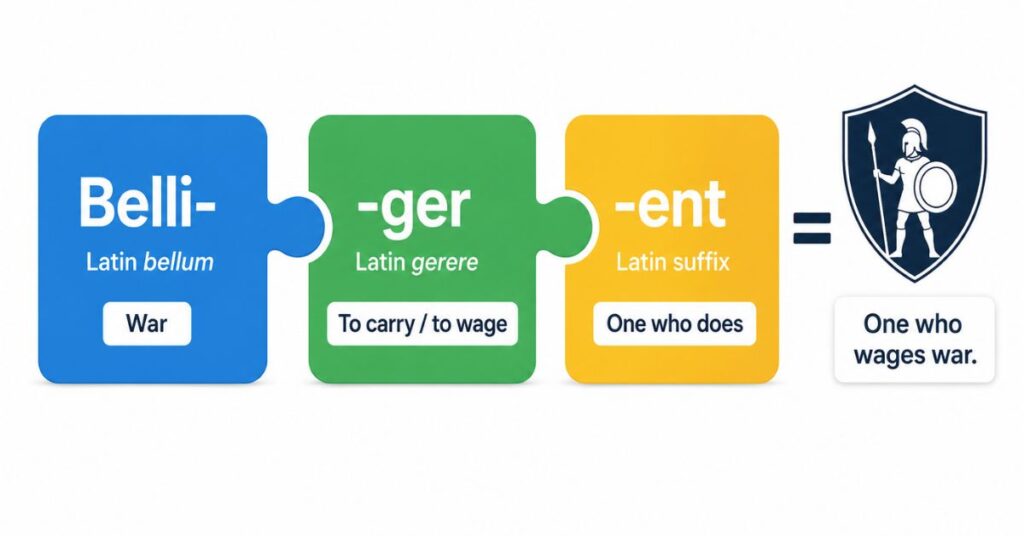
To understand the root, you have to look at the word’s structure:
| Part | Origin | Meaning |
| Belli- | Latin bellum | War |
| -ger | Latin gerere | To carry / to wage |
| -ent | Latin suffix | One who does |
Put together: belligerent = one who wages war.
The word entered English in the late 16th century, originally used only for nations at war. Over time, its meaning expanded to describe any person or attitude marked by aggression and confrontation.
So What Does the Root “Bel” Mean?
Here is the core answer:
The root “bel” (or “bell”) comes from the Latin word bellum, which means WAR.
When people ask “what does the root bel mean,” the answer is always the same: war, conflict, or fighting. It is not a standalone English root it traces back directly to classical Latin military language.
You will find this root hiding inside several common English words, all of which carry some connection to conflict, hostility, or aggression.
What Does the Root Word Bel Mean
To be precise, “bel” alone is a shortened reference to the Latin root bellum. In compound words, it appears as:
- bel- (as in belligerent)
- bell- (as in bellicose)
- -bellum (as in antebellum)
In all these cases, the meaning traces back to the same Latin source: war.
This root is completely separate from the English word “bell” (a ringing object) or the French word “belle” (meaning beautiful). Same sound, entirely different origins, a common source of confusion for learners.
Why Does “Bel” Mean War?
To answer this, we need to go back to ancient Latin.
In classical Latin:
- bellum = war
- belligerare = to wage war
- belligerans = one waging war (present participle)
Roman writers and military scholars used these terms constantly. When English began absorbing Latin vocabulary largely through French influence after the Norman Conquest, words built on bellum came along too.
So the “bel” sound in belligerent is not accidental or decorative. It carries over a thousand years of linguistic history, rooted in the language of Roman warfare.
Important Clarification: “Bel” Can Be Confusing
Many learners get tripped up because English has multiple unrelated words that share the “bel/bell” sound. Here’s how to keep them straight:
Bell (sound object)
- Comes from Old English
- Refers to a hollow ringing instrument (doorbell, church bell)
- Has nothing to do with war or Latin
Bell (war root in Latin words)
- Comes from Latin bellum
- Appears in words like belligerent, bellicose, and antebellum
- Always connected to war, conflict, or aggression
Think of it this way: if the word carries a sense of hostility or conflict, the “bell” you’re seeing is the Latin war root, not a ringing sound.
Words Related to the Root “Bellum” (War Root)
Once you understand that bellum = war, a whole group of English words clicks into place.
Bel Root Meaning Key Vocabulary
| Word | Root Breakdown | Meaning |
| Belligerent | bellum (war) + gerere (to wage) | Hostile, aggressive, war-like |
| Bellicose | bellum + -ose (full of) | Eager to fight; warlike in nature |
| Antebellum | ante (before) + bellum | Before the war |
| Rebellion | re- (again) + bellare | To wage war again; resist authority |
| Casus Belli | casus (cause) + belli (of war) | A justification or cause for war |
Let’s look at each one in a little more depth.
Belligerent
Already covered above. Describes someone aggressive, hostile, or ready to argue or fight. Works as both an adjective (“a belligerent attitude”) and a noun (“the belligerents in the conflict”).
Bellicose
Similar to belligerent but often more formal. It describes a general disposition toward fighting a personality trait rather than a specific behavior in the moment.
“The senator’s bellicose rhetoric alarmed neighboring nations.”
Antebellum
Ante means “before,” and bellum means “war.” So antebellum literally means before the war. In American history, it commonly refers to the period before the Civil War, describing the culture, architecture, and society of that era.
Rebellion (Related Concept)
The prefix re- means “again” or “back,” and bellare means “to make war.” So rebellion originally meant “to wage war again” a second uprising, a refusal to submit. Today, it means open resistance against authority or an established system.
Casus Belli
A Latin phrase still used in politics and international law. It means “cause of war,” a justification that a nation uses to explain or defend going to war.
“The attack was treated as a casus belli.”
How “Belligerent” Is Used in Modern English
Today, most English speakers use “belligerent” in everyday situations far removed from actual warfare.
Arguments
“He became belligerent during the discussion and refused to listen.”
Public behavior
“The protest turned belligerent when police arrived.”
Online behavior
“Stop being belligerent in the comments. No one is attacking you.”
Emotional reactions
“Her belligerent reply caught everyone off guard.”
In all these cases, the word signals active confrontation with someone not just upset, but aggressively pushing back or provoking conflict.
Belligerent in Social Media Language

On platforms like X (Twitter), TikTok, and Instagram, “belligerent” has taken on a slightly casual, sometimes humorous tone.
You’ll often see it used like this:
- “Why are you so belligerent today?”
- “Me going full belligerent in the group chat over nothing.”
- “Not me getting belligerent over a meme.”
Online, it’s used both seriously to call out genuinely toxic or aggressive behavior and ironically, to joke about overreacting to small things. The core meaning stays the same: someone acting confrontational or ready to pick a fight, even if it’s just over a Twitter thread.
Why Understanding Roots Like “Bel” Actually Helps
Learning individual words one by one is exhausting. But once you learn a Latin root, you unlock a cluster of vocabulary at once.
Knowing that bel = war immediately gives you:
- Belligerent: a hostile person or nation
- Bellicose: warlike personality
- Antebellum: before the war period
- Rebellion: fight against authority
- Casus belli: justification for war
Instead of five separate memorization tasks, you now have one root and five connected words. That is the real payoff of studying etymology. It turns vocabulary from a list into a system.
Common Misunderstandings About “Belligerent”
1. “Belligerent Means Violent.”
Not exactly. Belligerent describes attitude and behavior, not necessarily physical violence. Someone can be belligerent in tone, in text, or in their general demeanor without throwing a punch.
2. “It Has Something to do with Bells.”
No. The word “bell” as a ringing object comes from Old English and has no connection to the Latin war root. They look similar but come from entirely different linguistic traditions.
3. “Bel is a standalone English root.”
Not quite. It is a compressed reference to the full Latin word bellum. In English, “bel” only carries meaning when it appears as part of a Latin-derived compound word.
Simple Way to Remember It
Here is a memory trick that works:
Bel = Bellum = Battle
If you see “bel” in a word and the word has anything to do with fighting, aggression, or conflict, that is the Latin war root at work. Think of it as a hidden alarm bell going off: whenever “bel” appears, war-related meaning is nearby.
Examples to Lock It in Your Mind
Read these sentences to cement the root meaning:
- “The driver became belligerent after the minor accident.”
- “His bellicose attitude made negotiations impossible.”
- “The antebellum mansion was built before the Civil War.”
- “The rebellion began as a peaceful protest before turning violent.”
- “The border incident was cited as a casus belli.”
Notice how every single one of these words carries a sense of war, conflict, or aggression, all rooted in that same Latin bellum.
Why Words Like This Exist in English
English is not a pure language. It is a blend of Old English, Norse, French, Latin, and Greek built up over centuries of invasions, trade, and scholarship.
Words like “belligerent” exist because English educated its vocabulary heavily from Latin, especially through French influence after 1066. Legal, military, academic, and formal English all draw deeply from Latin roots.
That is why understanding even a handful of Latin roots like bellum for war, aqua for water, and port for carry gives you a surprisingly powerful key to the English vocabulary.
Final Breakdown (Simple Summary)
| Question | Answer |
| What does the root bel mean? | War (from Latin bellum) |
| Where does it come from? | Classical Latin military language |
| What is the full root word? | Bellum |
| Does it relate to bells (sound)? | No completely different origin |
| Key words using this root | Belligerent, bellicose, antebellum, rebellion, casus belli |
| Modern usage | Describes aggressive, hostile, or confrontational behavior |
Frequently Asked Questions
What does the root bel mean in the word belligerent?
It means war. Belligerent comes from Latin bellum (war) and gerere (to wage), meaning “one who wages war.”
Is “bel” a Greek or Latin root?
It is a Latin root, specifically from the word bellum, meaning war in classical Latin.
What is the difference between belligerent and bellicose?
Both come from the same Latin root, but bellicose describes a general warlike temperament, while belligerent refers to actively hostile or combative behavior.
Does the word “rebellion” come from the same root?
Yes. Rebellion comes from re- (again) and bellare (to make war), meaning to wage war again a resistance against authority.
Why do “bell” (ringing object) and “bel” (war root) look the same?
They are false friends, words that look alike but come from completely different origins. “Bell” (the sound object) comes from Old English, while “bel” (the war root) comes from Latin. English borrowed from many languages, which is why these overlaps exist.
Conclusion
So the next time someone asks what the root bel means, the answer is clear: bel comes from the Latin bellum, meaning war. It is the hidden engine behind words like belligerent, bellicose, antebellum, and rebellion, all of which carry some shade of conflict, aggression, or hostility.
Understanding this root does more than explain one word. It gives you a way to decode an entire family of vocabulary, recognize patterns across the English language, and build word knowledge that actually sticks. Once you see the system inside the language, learning becomes far less like memorization and far more like solving a puzzle.

I’ve been working in content writing since 2021 across multiple niches, with a strong focus on simplifying complex topics. On Maghints, I break down slang meanings, abbreviations, and internet terms clearly and simply so they’re easy to understand. My goal is to make modern online language simple and accessible for everyone.